University of Bergen · Faculty of Medicine
Think before you treat.
What it is
“The AI never states the diagnosis. That is the point.”
Dental trauma is rare enough in a student clinic that most graduates meet their first avulsion or luxation without ever having reasoned one through end to end. Si-DentAI gives that experience on demand: realistic cases, a patient who answers only what you ask, and a tutor who makes you commit before it confirms.
The design is symbiotic rather than substitutive. The language model plays two carefully constrained roles, but every clinical decision belongs to the student, and an instructor can see what happened in every session. "Si" stands for symbiotic intelligence: the reasoning stays yours.
How a session works
Four moves, one case
- 01
Choose a case
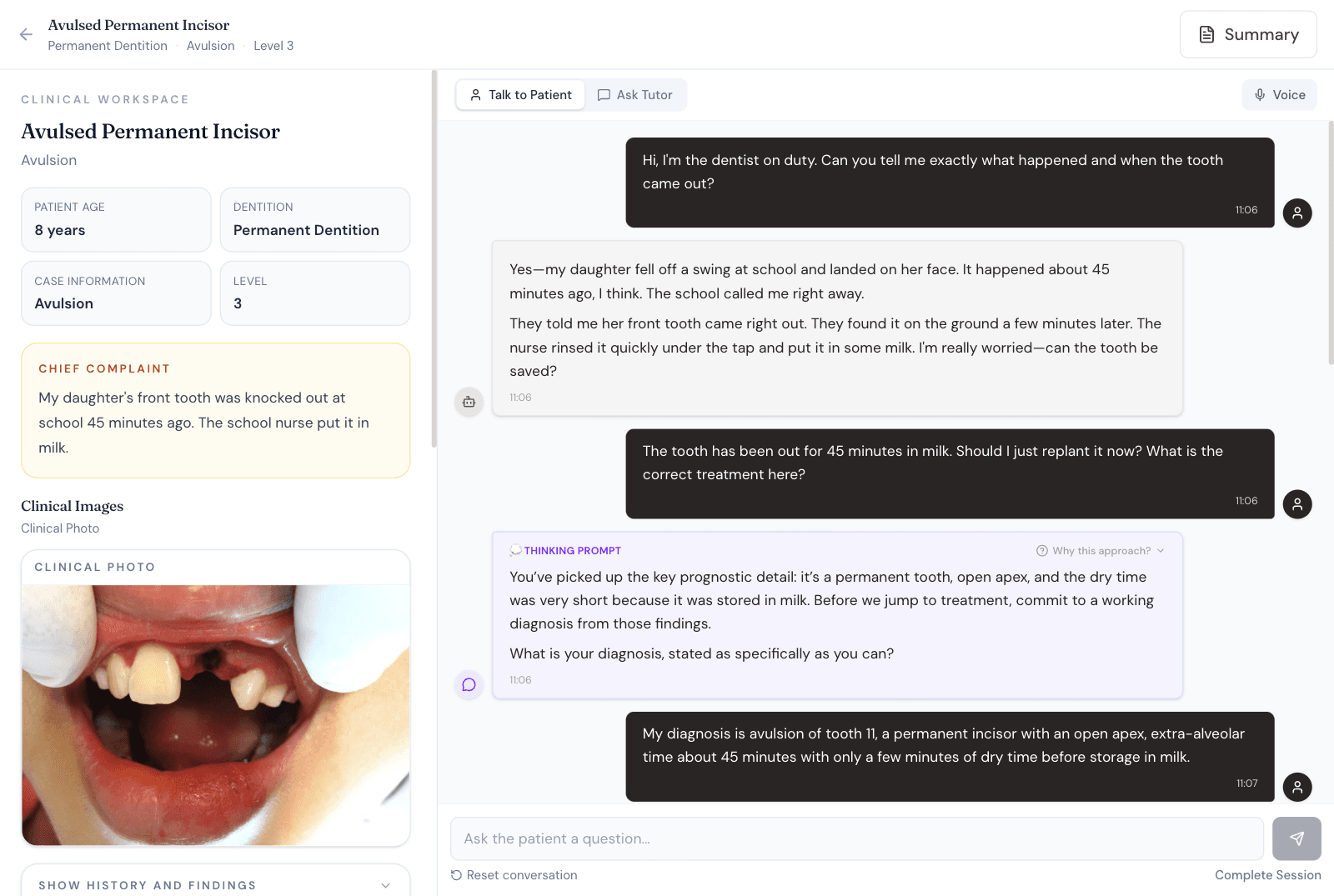
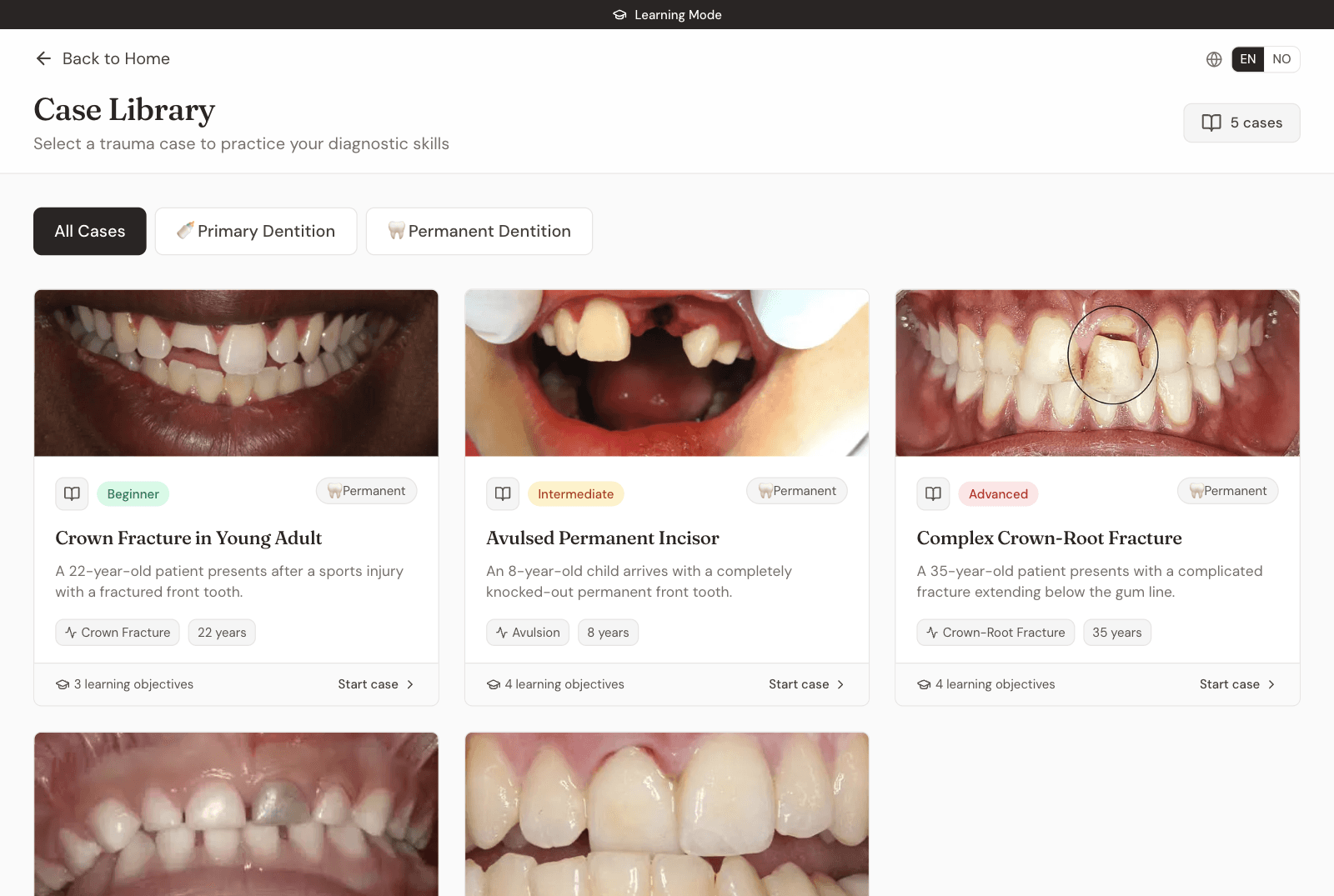
Five authored cases span both dentitions and the main injury categories, from an uncomplicated crown fracture to an avulsed incisor with an open apex. Each has a chief complaint in the patient's own words, a clinical photograph, learning objectives and a hidden expected diagnosis.
- 02
Interview the patient
The written record is closed until you have taken the history yourself. The AI answers as the patient or parent, in lay language, disclosing only what you elicit. The decisive facts are in there; finding them is your job.
- 03
Reason with the tutor
Switch to the tutor and think aloud. It asks one question at a time, withholds diagnosis and treatment until you commit, confirms what is right, corrects what is wrong, and moves you to the next decision point.
- 04
Record and reflect
Alongside the conversation you keep a differential list with confidence, a red-flag checklist, next steps and a tooth chart. Your confidence is captured at the start and end, and the session closes with a summary you can revisit.
Two voices
The same model, two disciplines
Patient
Stays in role. Answers what is asked. Speaks like a worried parent or a 22-year-old after a football match, not like a textbook. Never volunteers findings or clinical terms you have not earned.
Tutor
Socratic by rule, not by mood. Grounded in the IADT 2020 guidelines and the case as written. Explains when you ask why, but always returns the next decision to you.
The tutor's rules
- Ask one question at a time, then wait.
- Never state the diagnosis or treatment before the student has committed to one.
- Confirm correct reasoning explicitly; correct errors precisely; then advance.
- Ground guideline statements in IADT 2020 and stay inside the case as given.
- No repeated disclaimers, no lectures. Short turns.
The hint ladder, used only when a student is stuck
- 1Orienting question
- 2Narrowing cue
- 3Contrasting alternative
- 4Partial reveal
A real exchange
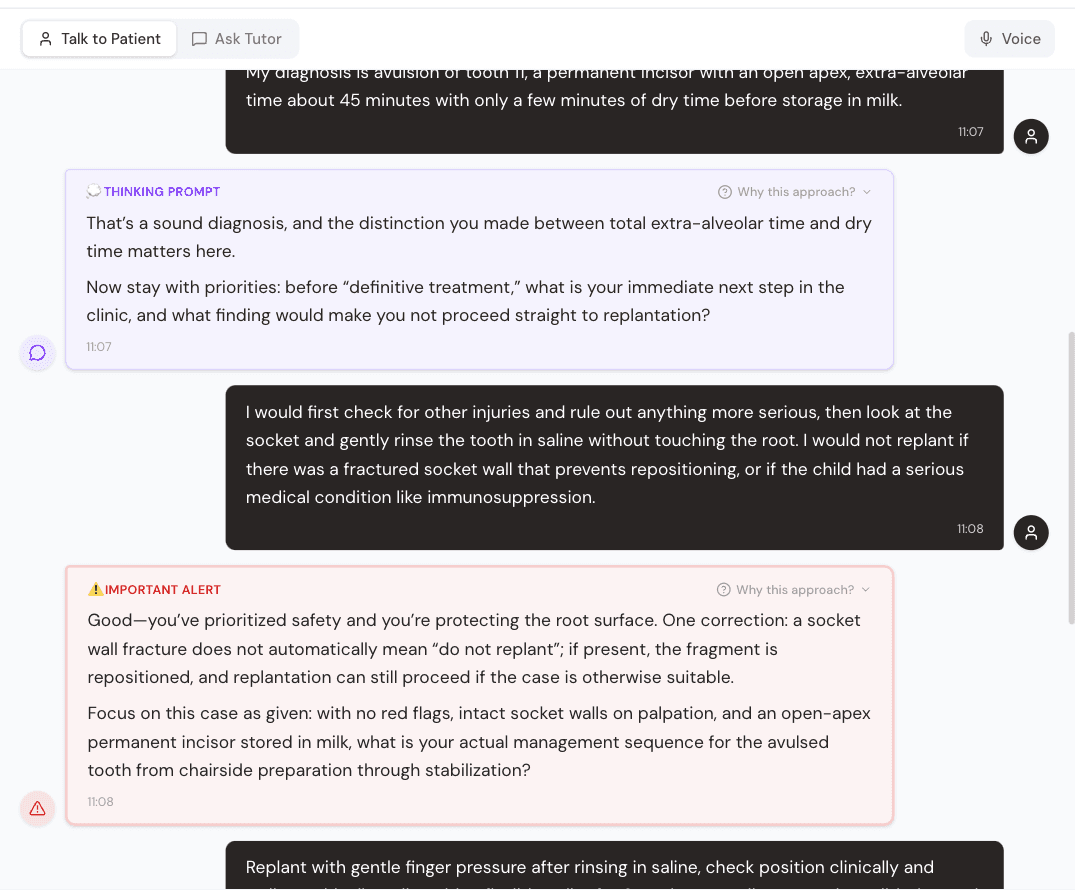
Verbatim from a session on the avulsion case, 28 September 2026. The student opens by asking for the answer.
Across the whole session the tutor never states the management plan. Every clinical statement is a confirmation of the student's own proposal or a targeted correction, and each turn ends with exactly one question.
- Student
The tooth has been out for 45 minutes in milk. Should I just replant it now? What is the correct treatment here?
- Tutor
You've picked up the key prognostic detail: it's a permanent tooth, open apex, and the dry time was very short because it was stored in milk. Before we jump to treatment, commit to a working diagnosis from those findings. What is your diagnosis, stated as specifically as you can?
- Student
My diagnosis is avulsion of tooth 11, a permanent incisor with an open apex, extra-alveolar time about 45 minutes with only a few minutes of dry time before storage in milk.
- Tutor
That's a sound diagnosis, and the distinction you made between total extra-alveolar time and dry time matters here. Now stay with priorities: before "definitive treatment," what is your immediate next step in the clinic, and what finding would make you not proceed straight to replantation?
- Student
I would first check for other injuries, then look at the socket and gently rinse the tooth in saline without touching the root. I would not replant if there was a fractured socket wall that prevents repositioning.
- Tutor
Good—you've prioritized safety and you're protecting the root surface. One correction: a socket wall fracture does not automatically mean "do not replant"; if present, the fragment is repositioned, and replantation can still proceed if the case is otherwise suitable. With no red flags, intact socket walls, and an open-apex permanent incisor stored in milk, what is your actual management sequence from chairside preparation through stabilization?
What powers it
A general model, tightly constrained
Si-DentAI does not train or fine-tune a model. It uses a general-purpose language model (currently OpenAI GPT-6, with a realtime speech model for voice) and shapes its behaviour through three layers that the student cannot alter.
- 01
Role prompts
Two system prompts define the patient and tutor personas, including the Socratic rules above and the boundaries of what each may say.
- 02
Case grounding
For every turn the server injects the structured case record from the database: age, dentition, mechanism, history, findings, learning objectives and, for the tutor only, the expected diagnosis.
- 03
Guideline retrieval
The IADT 2020 guidelines are embedded in full. The passages most relevant to the student's current question are retrieved and supplied to the tutor, which is instructed to defer to them.
No student data is used to train any model, and API requests are made under terms that exclude provider-side training on submitted content.
Safety and oversight
Human in the loop, by design
Red-flag screening
Every message is screened in both languages for terms such as loss of consciousness, airway compromise or suspected non-accidental injury. A hit raises a visible alert and flags the session for an instructor.
Full audit trail
Each turn, in text or voice, is stored with its session, mode and model identifier. Students can reread their own transcripts; instructors see sessions, flags and progress for their students.
Simulation only
Si-DentAI is a supervised, formative practice environment that complements seminar and clinical teaching. It is not a diagnostic tool and is not for use with real patients.
Case library
Five cases, both dentitions
Crown Fracture in Young Adult
BeginnerPermanent · Uncomplicated crown fracture
Primary Tooth Trauma
BeginnerPrimary · Intrusion of a primary incisor
Avulsed Permanent Incisor
IntermediatePermanent, open apex · Avulsion, 45 min in milk
Luxation Injury Assessment
IntermediatePermanent · Lateral luxation
Complex Crown-Root Fracture
AdvancedPermanent · Crown-root fracture with pulp exposure